A surprising number of Canoga Park injuries never happen on an open road. They happen in a parking lot. Westfield Topanga and The Village draw traffic from across the west Valley, and the aisles, garage ramps, crosswalk stripes and pedestrian gaps between parked cars produce collisions all day long, most of them at low speed and most of them denied. Add the retail lots along Sherman Way and Roscoe Boulevard, and lot cases become a steady part of the work here.
The rest of the pattern comes from the corridors themselves. Sherman Way, Topanga Canyon Boulevard, Canoga Avenue and Vanowen Street carry heavy through traffic, and the Metro Orange, now G, Line busway crosses several of them at grade, which creates a crossing type most drivers encounter nowhere else. Manoukian Law Firm is about ten minutes north on Topanga Canyon Boulevard in Chatsworth, and every file is prepared as though it will be tried.
What to do after an injury in Canoga Park
- Get evaluated the same day. Low speed does not mean low injury, and a same-day record removes an argument later.
- Report the incident to store or mall management before you leave and ask for a copy of the incident report.
- Photograph the hazard or the vehicle positions immediately, along with the aisle, the lighting, the level of the structure and the nearest store entrance.
- Photograph the ceiling and light poles for camera locations, then ask in writing that same week that the footage be preserved.
- If police responded, note the agency and the report number. If they did not, write down what happened while it is fresh.
- Get names and phone numbers from witnesses and from any employee who came to help.
- File a DMV form SR-1 within ten days if there was an injury or over $1,000 in property damage, as Vehicle Code 16000 requires.
- Speak with an attorney before giving a recorded statement to any insurance company.
Car accidents in Canoga Park
Canoga Park collisions come from two very different places. On the corridors, Sherman Way, Topanga Canyon Boulevard, Canoga Avenue, Roscoe Boulevard and Vanowen Street carry heavy through traffic, and the crashes are the boulevard kind: left turns across oncoming lanes, rear-end collisions at long signals, and side impacts where the Metro G Line busway crosses at grade. In the lots and garages at Westfield Topanga, The Village and the retail centers along Sherman Way and Roscoe, the crashes are slower, more numerous and far more often denied, with the insurer arguing that a parking-lot impact could not have hurt anyone.
Both kinds of case are won on evidence gathered early: the LAPD Topanga Division report for surface streets or the CHP report for the 101, the shopping-center and storefront camera footage, which is overwritten within days unless a written preservation request goes out, and the medical record from the first weeks. Treatment usually begins at UCLA West Valley Medical Center (formerly West Hills Hospital and Medical Center). The car accident page explains how a claim is valued from there. In one of the firm’s collision cases, the other side valued the client’s injuries at $5,000 to $10,000 and called the crash a soft impact; the client had been the third car struck in a chain-reaction collision. The firm filed suit and recovered $275,000. The first offer is a starting point, not a verdict on what the case is worth.
Truck and commercial vehicle crashes in Canoga Park
The industrial blocks north of Vanowen along Canoga Avenue and Owensmouth Avenue, the delivery traffic to the retail centers, and the 101 a few blocks south put box trucks, work vans and tractor trailers on Canoga Park streets every day. A crash with one of them involves the employer and the vehicle owner as well as the driver, larger commercial policies, and company records that must be preserved in writing within days. The San Fernando Valley truck accident page explains how the firm handles those cases.
Slip and fall injuries in Canoga Park
Falls in Canoga Park happen where the foot traffic is. Westfield Topanga at 6600 Topanga Canyon Boulevard and The Village next to it move heavy crowds through store aisles, parking structures, ramps and the walkways between them. The grocery and big box stores along Topanga Canyon Boulevard, Roscoe Boulevard and Sherman Way have the same problems on a smaller scale: a spill in an aisle, a wet entry mat on a rainy day, a pallet left in a walkway, a broken curb stop in the lot. In the residential blocks off Vanowen and Sherman Way, the hazard is usually a worn stair tread, a loose railing or a dark walkway at an apartment complex. At the Metro G Line stations at Canoga, Sherman Way and Roscoe, riders fall on platforms, at crossings and on the sidewalks leading in.
California decides these cases on a few questions. Under Rowland v. Christian, everyone who owns or controls property owes a duty of reasonable care to the people on it. The dispute is rarely about the duty itself. It is about notice of the hazard. Actual notice means an employee saw the hazard or a customer reported it. Constructive notice means it existed long enough that the owner should have known. The next question is what the owner did about it: was the condition fixed, blocked off or marked with a warning, and was that done within a reasonable time?
Those questions are answered by records the property owner already has. Most stores prepare an incident report when a customer falls, many keep sweep logs showing when an aisle was last checked, and cameras cover the entrances, aisles and parking structures. A sweep log showing an inspection an hour before the fall and a recording showing the spill sitting there for forty minutes tell two different stories, and only one of them is volunteered. Camera systems overwrite on a cycle that can be as short as a few days, which is why a written preservation request goes out the first week, not after treatment ends. The slip and fall page explains how the firm builds a store or parking structure case from those records. Falls on stairways and common areas at rental buildings follow the same notice rule, usually with a maintenance history behind them, and are covered on the apartment injury page.
Other injury cases we handle in Canoga Park
Parking lot collisions and falls are ordinary car accident and slip and fall claims with one complication: the evidence lives on a private camera system that can overwrite within days. A fall case is decided on notice, meaning whether the owner knew or should have known about the hazard and whether it was cleaned, repaired or warned about, under the duty of care described in Rowland v. Christian. A spill logged in a sweep sheet an hour before your fall is a different case than one nobody documented, and those records are obtained rather than volunteered.
Because so much of the movement here is on foot between a car and a store entrance, pedestrian accident claims are common. Vehicle Code 21950 requires drivers to yield in marked and unmarked crosswalks, and the striped lot crossings and unsignalized corners along Sherman Way are where drivers most often assume they have priority.
The busway crossings put bus accident claims in a category of their own, because a public transit agency is a government entity. A written claim is generally due within six months under Government Code 911.2 rather than the usual two years, and the vehicle almost certainly carries onboard video that has to be requested in writing right away.
Bicycle accident claims apply Vehicle Code 21200, which gives cyclists the rights and duties of drivers, and the three foot passing rule in Vehicle Code 21760, both of which come up on the wide, fast stretches of Roscoe and Vanowen. Motorcycle accident cases start from lane splitting being lawful under Vehicle Code 21658.1. Shopping traffic also produces rideshare accident claims, where the coverage available depends on the driver’s period under Public Utilities Code 5433, reaching a one million dollar policy while a passenger is on board. In the dense residential blocks off Vanowen and Sherman Way, apartment complex injuries turn on the same notice question as any premises case, usually with a maintenance history behind it.
Where Canoga Park cases are handled
Collisions and incidents on Canoga Park streets, including the busway crossings, are generally reported by the LAPD Topanga Division. Nearby freeway crashes are usually investigated by the California Highway Patrol. Private property collisions in a mall lot may not generate a police report at all, which makes your own documentation the record.
Emergency care generally means UCLA West Valley Medical Center, a short drive west. Keep the discharge paperwork, imaging orders and referrals, and follow the recommended treatment. A steady record is what makes a low speed lot collision credible, because insurance companies routinely treat minor vehicle damage as proof of minor injury.
If a lawsuit becomes necessary, Canoga Park cases go to the Los Angeles Superior Court and civil matters are generally handled at the Van Nuys Courthouse on Sylmar Avenue. Assignments are set by the court and can change, so the filing location is confirmed for each case rather than assumed.
What the attorney sees most from Canoga Park
The crashes that bring Canoga Park clients to the firm happen on the surface streets more than on the freeways: Nordhoff, Roscoe, Devonshire and Topanga Canyon, at the signals, in stop-and-go traffic near the ramps and shopping centers, and in the parking lots themselves. Left-turn and intersection collisions, rear-end crashes, and pedestrians or cyclists hit in crosswalks make up most of the files. Off the road, it is falls at grocery and big-box stores and collisions with rideshare and delivery drivers.
Clients are usually treated at Kaiser Permanente Woodland Hills, UCLA West Valley Medical Center or Northridge Hospital. Injury lawsuits are filed downtown at the Stanley Mosk Courthouse under the court’s Local Rule 2.3 and may later be transferred to the Chatsworth or Van Nuys courthouse. Most resolve before trial; a filed case runs 12 to 24 months and includes a deposition and often a defense medical examination, both of which the firm prepares clients for in detail.
Why work with Manoukian Law Firm
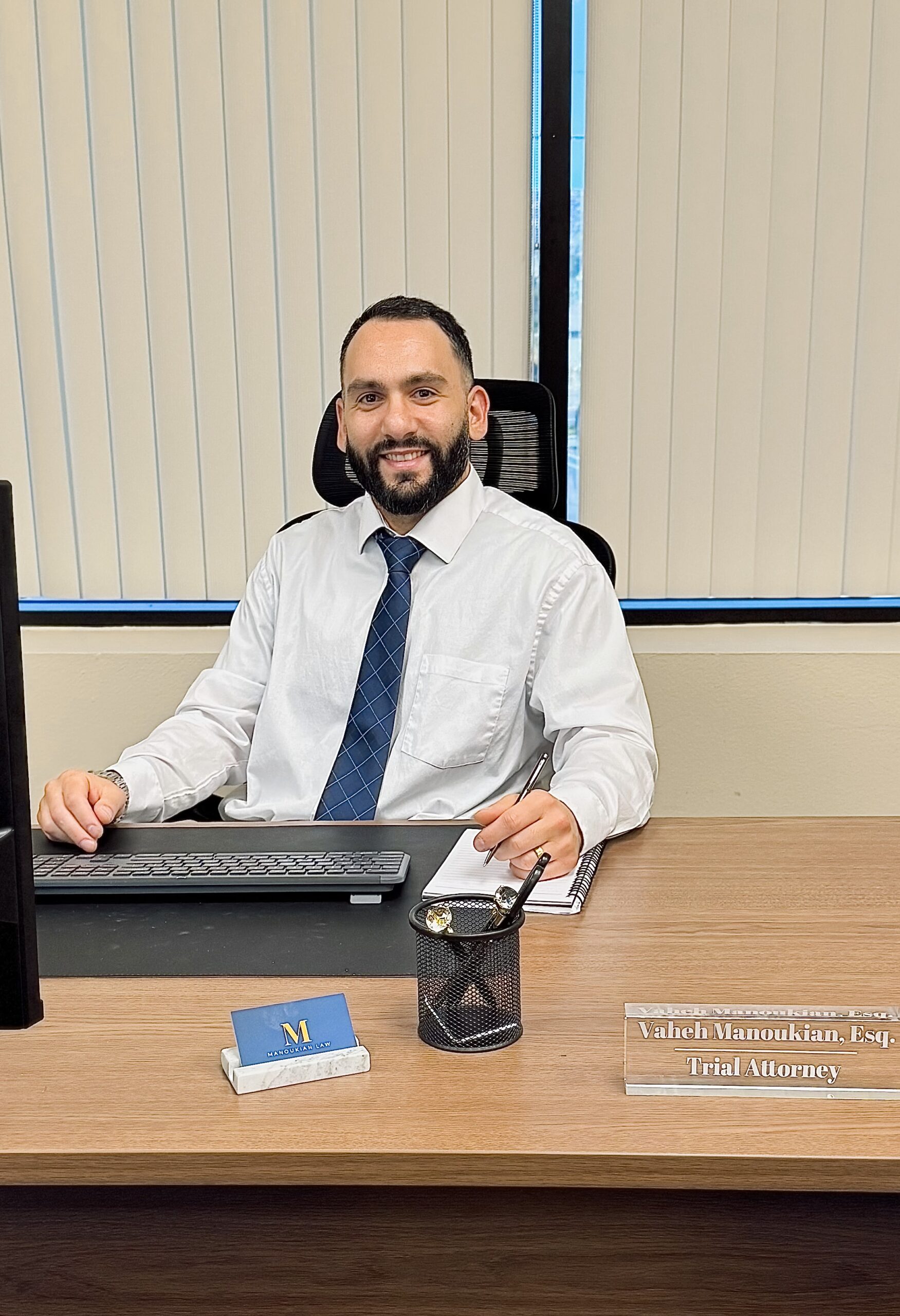
Manoukian Law Firm was founded by Vaheh Manoukian, a graduate of the USC Gould School of Law and UCLA who handled depositions and trials at a larger firm before opening his own. The firm belongs to the Consumer Attorneys Association of Los Angeles and Consumer Attorneys of California, its founding attorney was selected to the Super Lawyers Rising Stars list for 2027.
Premises cases are won or lost in the first two weeks, on preservation letters and on getting to the property before anything changes. Ten minutes away means that happens quickly, and it is the attorney on your case who does it. Meetings can be held at the Chatsworth office, at the hospital, or by phone and video. Consultations are free, the firm works on a contingency fee, and there is no fee unless we win. The firm helps clients in English, Spanish and Armenian. There is more on the about page, and past matters are described on the case results page. Neighboring communities are covered on the West Hills and Woodland Hills pages.
Case results
Our client suffered catastrophic injuries after being struck by a commercial delivery driver who was on the job.
Our client developed ongoing neck pain after a multi-vehicle rear-end collision on the highway, requiring pain-management treatment. The case resolved for $400,000.
The other side valued our client's injuries at $5,000 to $10,000 and called it a “soft impact.” Our client was the third car struck in a chain-reaction collision. We filed suit and recovered $275,000.
Past results do not guarantee a similar outcome.
Frequently asked questions
No police report was taken in the parking lot. Can I still bring a claim?
Yes. Police often do not respond to private property collisions. What replaces the report is your own evidence: photographs, the store or mall incident report, witness contact information, and surveillance footage requested before it is overwritten.
The store says the floor was dry when they checked. What then?
That is a notice argument, and it is answered with records. Sweep logs, inspection schedules, prior complaints, maintenance tickets and video all speak to whether the hazard existed long enough for the owner to know about it under Rowland v. Christian.
A Metro bus was involved. Is the deadline different?
Yes. A transit agency is a public entity, so a written claim is generally due within six months under Government Code 911.2, with a lawsuit deadline after that claim is rejected. The shorter timeline is a reason to get advice quickly rather than waiting.
I fell in a store or parking structure at Westfield Topanga. Is the store or the mall owner responsible?
It can be either, or both. A tenant is generally responsible for the space it controls, such as its own sales floor, while the mall owner or its management company is generally responsible for common areas like parking structures, corridors and walkways, and the lease often shifts maintenance duties between them. The claim is made against whoever controlled the area where you fell, and the lease, the maintenance contracts and the incident report show who that was.
What will this cost me?
Nothing up front. The consultation is free whether or not you hire the firm, and you can reach the office through the contact page.
If you were injured in Canoga Park, call (818) 818-5031 for a free consultation. The consultation is free, and there is no fee unless the firm recovers for you.