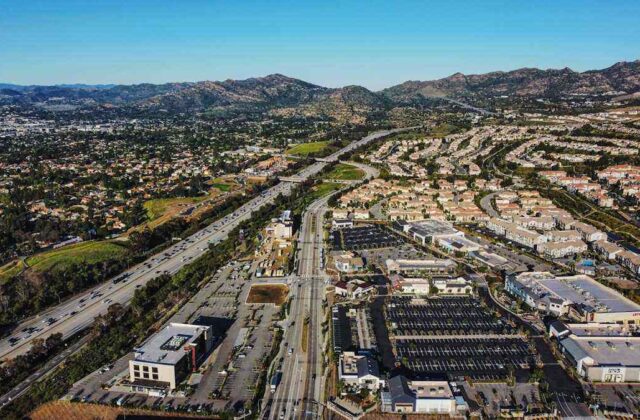
The 118 between Chatsworth and Simi Valley crosses from Los Angeles County into Ventura County somewhere past Rocky Peak, and that line changes almost everything about how your crash gets handled. The agency that responds is the California Highway Patrol, not a local police department, and which CHP office writes the report depends on which side of the pass you were on. If the case goes to a lawsuit, the county line can decide which courthouse hears it.
None of that is obvious from the driver’s seat. You know a car hit yours, or that traffic stopped and did not start again in time. This guide walks through what happens after a crash on that stretch of freeway, from the report to the hospital to the question of who pays, so you are not figuring it out for the first time while you are still sore.
Who responds: the CHP, not a city police department
Freeway crashes in California are handled by the California Highway Patrol, regardless of which city or county the freeway runs through. On the 118 between Chatsworth and Simi Valley, that means two different CHP area offices depending on where the collision happened. The Los Angeles County stretch, from the 405 through Chatsworth and Porter Ranch out toward Rocky Peak, generally falls under the CHP’s West Valley area office. Once you cross into Ventura County near Simi Valley, the CHP’s Moorpark area office generally has jurisdiction.
This matters for one practical reason: the report is filed with the office that responded, and that is the office you contact to request a copy. A person who calls the wrong CHP office because the crash felt like it happened in “Chatsworth” when the mile marker was already in Ventura County loses time chasing the report down.
Local police get involved only if the crash happened on a surface street feeding the freeway, or an officer from another agency happened to be first on scene and stayed until CHP arrived. If your crash started on the freeway and ended there, expect a CHP unit and a CHP report rather than paperwork from LAPD or Simi Valley Police.
Getting the CHP report
CHP crash reports are not available immediately. It typically takes several days to a couple of weeks for the report to be entered into the system after an officer completes it, longer for a fatal or complex multi-vehicle crash. When it is ready, you request it using CHP Form 190, the Request for Copy of Traffic Collision Report, available through the CHP’s website or in person at the area office that handled the crash.
You generally need to be a party to the crash, an authorized representative, or have another qualifying interest to get a copy, and there is a small fee. If you were transported from the scene and never spoke with the reporting officer, or the officer’s narrative includes a fault determination you disagree with, an attorney can request the report and walk through it with you rather than you reading it alone for the first time.
The exits where these crashes happen
The 118 through this corridor has a predictable pattern of trouble spots. Topanga Canyon Boulevard and De Soto Avenue see heavy merge traffic during the morning and evening commute, with sudden slowdowns as drivers exit toward Chatsworth and Winnetka. Tampa Avenue and Reseda Boulevard carry similar commuter volume closer to Northridge. Further west, the climb and descent around Rocky Peak and the Kuehner Drive exit into Simi Valley is where speed differential becomes the bigger risk: traffic can be moving 70 miles per hour one moment and stopped behind a stalled vehicle or an earlier crash the next, with limited sightlines on the grade.
Multi-car chain reactions and how fault gets sorted
A rear-end chain reaction on the 118 rarely stops at two cars. When traffic backs up quickly on the grade near Rocky Peak, or in the merge zones near De Soto and Tampa, a driver going too fast for conditions can push three or four vehicles together. Sorting out fault in a chain reaction is not as simple as “the car in back hit the car in front.”
California courts apply pure comparative negligence, meaning more than one driver can share responsibility, and each driver’s share reduces their own recovery without barring it entirely (Li v. Yellow Cab, 1975). In a chain reaction, the driver who caused the initial impact usually bears most of the responsibility, but a driver following too closely in the middle of the chain can share some of it even if they were also hit from behind. This is one of the reasons a multi-car crash on the freeway takes longer to resolve than a simple two-car rear-end collision on a surface street. Photographs of the damage pattern on each vehicle, the CHP report’s diagram, and any available video become the evidence that sorts out who owes what to whom.
Where people go for emergency care
Depending on where the crash happens along this stretch and which direction traffic can move, ambulances generally head to one of three emergency rooms. Northridge Hospital Medical Center serves the Los Angeles County side near the De Soto and Tampa exits. West Hills Hospital is a common destination for crashes closer to Chatsworth and the 101 interchange area. Once you are past Rocky Peak into Ventura County, Simi Valley Hospital is the closer emergency department.
Which hospital you end up at is not a decision you will usually make yourself in the moment, and it does not matter for your claim which one it is. What matters is that you go, and that the records from that visit describe your symptoms in your own words as closely as possible. An emergency room note that says “patient denies pain” because you were in shock and did not yet feel the injury that shows up the next morning can become a problem later. If that happens to you, see a follow-up provider promptly and say clearly what has changed.
The county line question: which court hears the case
If your case does not resolve with the insurance company and a lawsuit becomes necessary, the county where the crash occurred generally determines which superior court has jurisdiction. A crash on the Los Angeles County side of the 118, including through Chatsworth, is typically filed in the Los Angeles Superior Court. A crash that occurred after the county line, on the Ventura County side near Simi Valley, is typically a matter for Ventura County’s superior court instead.
This is not a technicality you need to resolve yourself. It matters for choosing where a lawsuit gets filed and, practically, for how a case is prepared and who the medical providers and witnesses are likely to be. It is one more reason the exact location of impact, not just “the 118 near Simi Valley,” belongs in the crash report and in your own notes as soon as you can write them down.
Dashcams, Caltrans cameras, and a shrinking window
Two sources of video exist for most freeway crashes on this stretch, and both disappear faster than people expect. Caltrans operates traffic cameras along the 118 for monitoring congestion and incidents, but those feeds are typically not stored for long, so getting historical footage generally requires a formal request made within days of the crash. A private dashcam, either your own or another driver’s, is the more reliable source, and footage on a personal device or a cloud account can be recorded over or auto-deleted within days depending on the settings.
If you or anyone near you had a dashcam running, save the file immediately, before the memory card cycles. If you believe there is Caltrans or nearby business camera footage, a request should go out as early as possible, because a delay of even a few weeks can mean the footage is already gone by the time anyone asks for it.
What to do in the first hour
- Get off the traffic lanes if your car is drivable and it is safe to do so, and turn on hazard lights.
- Call 911 and confirm CHP is responding, especially if the crash location is near the county line.
- Photograph the scene, the vehicles, the skid marks, the mile marker or nearest exit sign, and the freeway direction before anything moves.
- Get the other driver’s insurance information and license plate, and note the direction they were traveling.
- Ask any witness who stopped for a phone number before they leave.
- Save any dashcam footage from your own vehicle the same day.
- Go to the emergency room or urgent care if you have any pain, even if it seems minor at the scene.
- Note the approximate location relative to the county line if you know it, or the nearest exit.
- Request the CHP report using Form 190 once enough time has passed for it to be filed.
- Keep a folder, physical or digital, of every document connected to the crash from that first day forward.
Key points
- Freeway crashes on the 118 are handled by the CHP, generally the West Valley area office on the Los Angeles County side and the Moorpark area office once you cross into Ventura County.
- Request the CHP report using Form 190 after giving the department time to file it, typically several days to a couple of weeks.
- Multi-car chain reactions near the Rocky Peak grade and the busy exits at De Soto, Tampa, and Reseda involve comparative fault analysis, not a simple front-to-back rule.
- Northridge Hospital, West Hills Hospital, and Simi Valley Hospital are the emergency rooms most crashes on this corridor reach, depending on location.
- Where the crash happened relative to the county line can affect which superior court would hear a lawsuit.
- Dashcam and Caltrans camera footage should be preserved within days, not weeks, because both are routinely overwritten or deleted.
Frequently asked questions
Who investigates a crash on the 118 if it happens right at the county line?
The agency that arrives first typically handles it, and CHP units from either the West Valley or Moorpark area office may respond depending on dispatch and location. The report should state the location as precisely as possible so there is no confusion later about which county the crash occurred in.
How long does it take to get a CHP report after a crash on the 118?
It commonly takes anywhere from several days to a few weeks, longer for a serious multi-vehicle crash or one involving a fatality. Calling the area office that responded is the fastest way to check on status before filing Form 190.
Does it matter which hospital I went to after the crash?
No. Northridge Hospital, West Hills Hospital, and Simi Valley Hospital are all appropriate emergency departments for this area, and your claim is not affected by which one treated you. What matters is that you were seen and that your symptoms are documented.
Can I still get Caltrans footage weeks after the crash?
Usually not. Caltrans camera feeds are generally not retained for long, and a request made weeks after the crash often comes back empty. If footage might exist, the request should go out as soon as possible after the crash.
A crash on the 118 between Chatsworth and Simi Valley brings questions that a crash on a city street does not, from which CHP office wrote the report to which county a lawsuit would be filed in. Manoukian Law Firm is based in Chatsworth and works with clients on both sides of that county line. Call (818) 818-5031 for a free consultation, reach out through our contact page, or read more about what to do after a car accident in Los Angeles and about handling a Chatsworth crash from the police report through the hospital visit. The Chatsworth and Simi Valley location pages have more on how we handle cases in each area, and the truck accident page covers what changes when the other vehicle is a commercial truck, which on the 118 is often the case. The firm helps clients in English, Spanish and Armenian. Consultations are free and there is no fee unless we win.