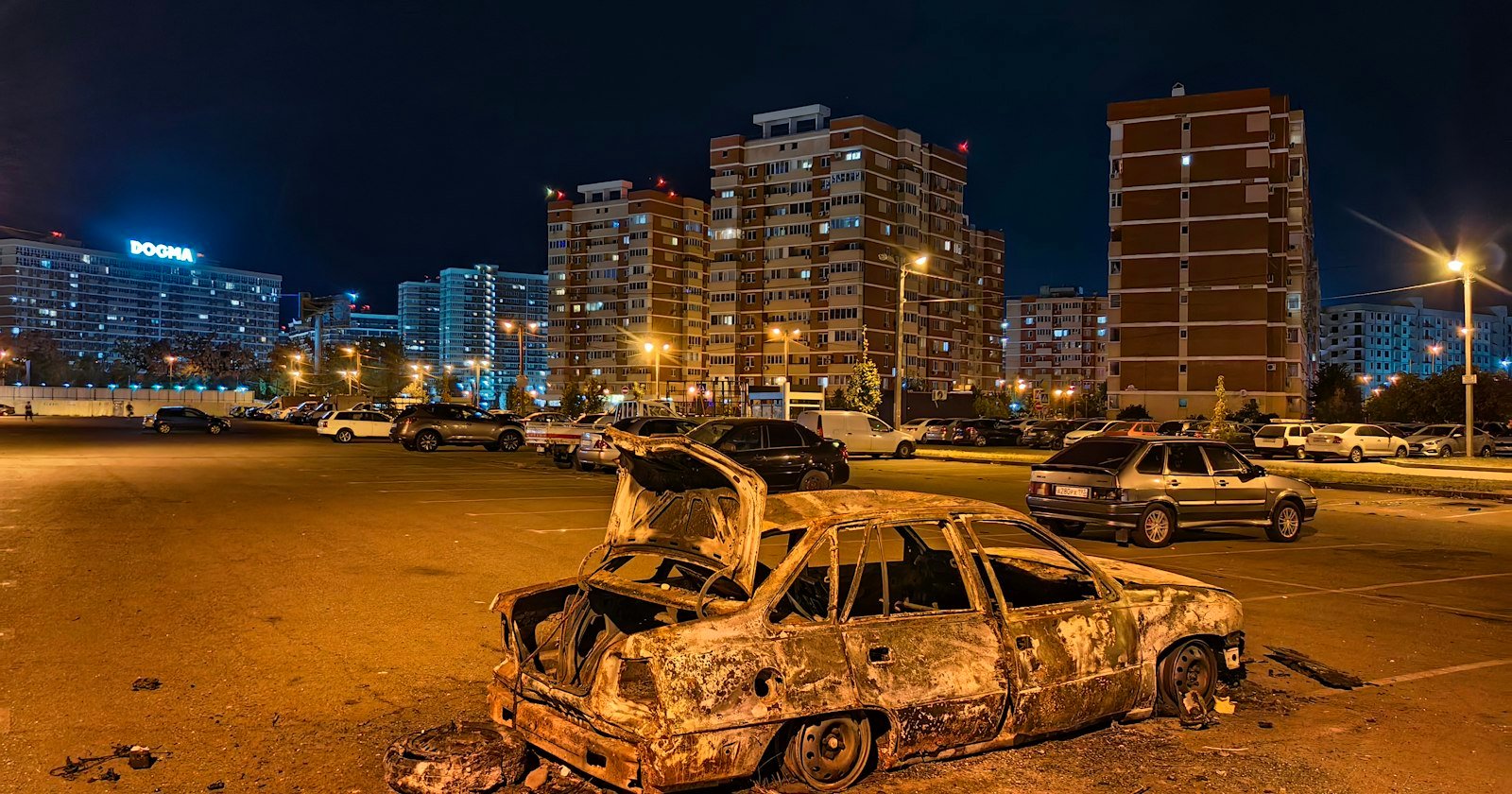
If your car caught fire after a collision in California and you or a passenger was burned, you may have two separate claims, and the second one is often the larger. The first is against the driver who caused the crash, for everything the crash did. The second is against the company that built the vehicle, if the fire should not have happened. Cars are designed and tested so that a survivable crash does not become a fire. Federal fuel system standards exist for exactly that reason, and electric vehicle batteries are designed to contain thermal failures. When a moderate collision produces a fire that burns an occupant, the question of whether the vehicle performed as it should have is a real one, and it is answered by engineers, not by the insurance adjuster. Here is how both claims work, why the car itself must be preserved, and what to do now.
The claim against the other driver
A driver who causes a collision is responsible for all of the harm that flows from it, including burns from a fire the crash started. Negligence, comparative fault, the two-year deadline under Code of Civil Procedure section 335.1 and the other driver’s liability limits all apply as in any crash. The problem in a serious burn case is that the other driver’s policy is usually small. California’s minimum liability limits are low, and even a driver with a $100,000 or $250,000 policy cannot begin to pay for weeks in a burn unit, grafting and a lifetime of reconstructive care. Your own uninsured and underinsured motorist coverage adds a layer. After that, the only source of full compensation is often the manufacturer.
The claim against the manufacturer
California holds manufacturers strictly liable for injuries caused by a defective product, a rule the California Supreme Court established in Greenman v. Yuba Power Products in 1963 and has applied to vehicles ever since. In a post-collision fire case, the defect theory is usually one of these.
Fuel system integrity. Federal Motor Vehicle Safety Standard 301 requires that a vehicle’s fuel system limit fuel leakage in specified front, rear and side crash tests. A fuel tank that ruptures, a filler neck that tears away, or a fuel line that separates in a crash of moderate severity can be a design or manufacturing defect even if the vehicle passed the federal test, because the federal standard is a floor, not a ceiling, and California juries decide defect by their own standards.
Electric vehicle battery fires. Lithium-ion battery packs are designed with structural protection and systems to prevent thermal runaway, the chain reaction that produces an intense, hard-to-extinguish fire. A pack that ignites after a crash that should not have breached it, or that ignites with a delay that traps occupants, raises the same design questions. These fires also burn hotter and longer than gasoline fires and can reignite, which affects both the injuries and the evidence.
Crashworthiness and egress. A fire that would have been survivable if the doors had opened, the windows had worked or the seat belt had released is a defect case about those systems, not only about the fire.
Component suppliers. The fuel tank, the battery pack and the electrical components are often made by other companies, which are named with the vehicle manufacturer.
A recall or a technical service bulletin for the vehicle’s fuel or battery system is strong evidence and is checked in every case through the National Highway Traffic Safety Administration’s database, but the absence of a recall does not mean the design was safe.
The vehicle is the evidence. Do not let it go.
This is the step that decides product cases, and it is lost in the first two weeks more often than any other. After a fire, your own insurer or the other driver’s will move to total the vehicle, pay you, and send it to a salvage auction, where it is sold and crushed. Once that happens, the fuel system or the battery pack cannot be examined, and the manufacturer will argue that nothing can be proven. The vehicle, every part of it, including parts the fire department removed, has to be preserved in a secure storage facility, and the insurer has to be told in writing that it may not be released, repaired or salvaged. Storage costs money; it is money well spent, and it is recoverable. The same goes for the other vehicle, the scene evidence, the fire department’s report and photographs, and any event data recorder in either car.
The investigation
A post-collision fire case is investigated by a fire origin-and-cause expert who follows the methodology in NFPA 921, the national guide for fire investigation, together with an automotive engineer who examines the fuel or battery system and a crash reconstructionist who establishes the severity of the collision. The reconstruction matters because the manufacturer’s defense is almost always that the crash was so severe that no design could have prevented the fire. The event data recorder, the crush measurements and the physical evidence answer that. The fire department’s incident report and the firefighters who responded are the first witnesses, and their photographs are obtained immediately.
The injuries and treatment
Vehicle fires produce flame burns, inhalation injuries from smoke and superheated air, and in electric vehicle fires, exposure to toxic gases. Burn depth, the percentage of body surface burned and inhalation injury together determine the severity. In the West San Fernando Valley, serious burns are treated at the Grossman Burn Center at West Hills Hospital, and the most severe at the burn centers at LAC+USC or Torrance Memorial. Treatment runs from debridement and grafting through months of therapy and pressure garments to reconstructive surgery years later, and a life care planner projects all of it for the claim.
What to do now
Do not sign the total loss paperwork or release the vehicle. Tell your insurer in writing that the vehicle must be preserved and not salvaged. Get the fire department’s incident number. Photograph everything you can of the vehicle, the scene and your injuries. Identify the vehicle’s exact year, make, model and VIN, and check the NHTSA recall database. Get witness names, especially anyone who saw how quickly the fire started and spread. Keep every piece of clothing and equipment from the crash. Do not give a recorded statement to any insurer, including the manufacturer’s, which may contact you directly.
Key points
A post-collision fire can support two claims: against the at-fault driver for the crash, and against the manufacturer under strict product liability if the fuel system, battery or crash protection failed.
Federal fuel system and battery design standards are a floor. California juries decide defect by California standards.
The vehicle must be preserved and not salvaged. Once it is crushed, the product claim is usually gone.
Fire origin-and-cause, automotive engineering and crash reconstruction experts build the case; the fire department’s report and the event data recorder are obtained first.
Burn treatment is long and expensive; the other driver’s policy is rarely enough, which is why the manufacturer claim matters.
Frequently asked questions
The other driver’s insurer already paid for the car and took it. Is the product claim over? Find out where the vehicle is immediately. Salvage yards hold vehicles for a period before auction, and a preservation demand to the yard and the insurer can sometimes stop it. Every day matters.
The crash was my fault. Can I still claim against the manufacturer? Yes. A manufacturer is responsible for a defect that made a crash’s consequences worse regardless of who caused the crash. Your fault for the collision may reduce the recovery but does not bar a product claim for the fire.
The car was ten years old. Does that matter? Age affects the analysis but does not defeat the claim. Fuel system integrity is supposed to last the life of the vehicle, and a defect that was present from manufacture is actionable when it causes injury.
How long do I have? Two years from the injury under Code of Civil Procedure section 335.1 for both the driver and the manufacturer. The evidence, however, is lost in weeks, not years.
Manoukian Law Firm, P.C., Chatsworth, California. Free consultation. No fee unless we win. Past results do not guarantee a similar outcome.