If you tripped on a lifted sidewalk slab in Northridge, Reseda, Van Nuys or North Hollywood, the claim in most cases goes to the City of Los Angeles, and it has to reach the City Clerk within six months of the fall under Government Code 911.2. The claim can be filed online at claims.lacity.org or in person or by mail at 200 North Spring Street, Room 395. Faxed and emailed claims are not accepted. Everything else in the case is built to survive the two arguments the City makes in these cases: that the lift was too small to count, and that nobody at the City knew about it.
This guide takes the steps in order, from the photographs to the filing. Our general guide to the six-month government claim deadline covers the process for every kind of public entity. This post is about City of Los Angeles sidewalks.
Photograph the lift the same day
The most valuable evidence in a sidewalk case is a measured photograph taken before anything changes. Lifts get ground down, ramped with asphalt or marked with paint within days of a complaint, and a repaired sidewalk cannot be measured.
Go back, or send a family member, and take these photographs:
- A close shot of the raised edge with a ruler standing against it, at the highest point and where your foot caught. Lifts are rarely even, so measure both ends.
- The same edge from the direction you were walking, at eye level, at the same time of day if light was a factor.
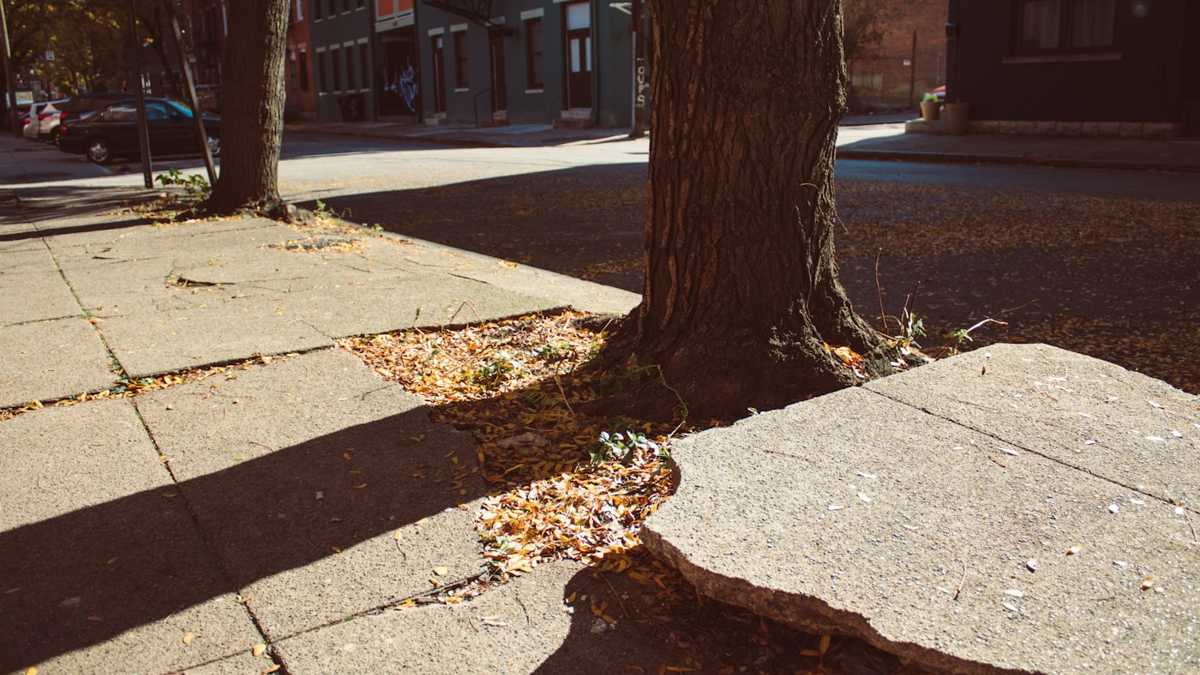
- A wide shot showing the parkway tree, its roots and the slab. A root-lifted slab usually means the lift has been growing for years.
- Anything that made the lift harder to see: leaves, shade from the canopy, a dark streetlight, a jagged or crumbling edge.
- The nearest house number, the cross streets, and your shoes.
Get a name and number from anyone who saw you fall, and get medical care the same day. Tell the provider where and how you fell so it lands in the chart.
How big does the lift have to be
Every City sidewalk case runs into the trivial defect doctrine. Government Code 830.2 says a condition is not dangerous if a court decides the risk was so minor that no reasonable person would call it a substantial risk of injury. In Huckey v. City of Temecula (2019) the court of appeal held that the doctrine is not an affirmative defense but “an aspect of duty that a plaintiff must plead and prove.”
Height is the most important factor, but as the court said in Stathoulis v. City of Montebello (2008), “a tape measure alone cannot be used to determine whether the defect was trivial.” The published decisions fall into a rough pattern. Lifts under about three-quarters of an inch, with nothing else wrong, are frequently held trivial as a matter of law, and the range from there to one and a half inches is contested and fact dependent. Once the size “begins to stretch beyond one inch the courts have been reluctant to find that the defect is not dangerous as a matter of law,” a line the Fifth District endorsed in Stack v. City of Lemoore (2023) while affirming a jury verdict on a one and three-quarter inch lift. Lifts that size or larger have almost never been called trivial.
Circumstances matter at every size. Poor lighting, leaves over the edge, a jagged lip, shadow, and prior complaints or falls at the same spot can all pull a case out of the trivial category. The general premises rules on notice, explained in our post on Rowland v. Christian, sit behind all of this, but for public property the Government Code controls.
What Government Code 835 requires
Government Code 835 requires proof that the property was in a dangerous condition at the time of injury, that the condition caused the injury, that it created a reasonably foreseeable risk of the kind of injury that happened, and that either a City employee negligently created the condition, or the City had actual or constructive notice of it long enough before the fall to have done something about it.
Notice is defined in Government Code 835.2. Actual notice means the City knew the condition existed and knew or should have known it was dangerous. A prior MyLA311 request about that slab is the classic proof, and general knowledge that sidewalks lift is not enough. Constructive notice means the condition existed long enough and was obvious enough that a reasonably adequate inspection system should have found it. Tree-lifted sidewalks are strong on constructive notice because roots move concrete slowly. We request StreetsLA service request histories, inspection records and work orders for the block through a California Public Records Act request.
The Willits settlement and the repair queue
Willits v. City of Los Angeles was a class action filed in 2010 over inaccessible sidewalks. The City reached a settlement in 2015 that a federal judge approved on August 25, 2016, committing $1,367,142,684 over thirty years to sidewalk and access improvements, carried out through the Safe Sidewalks LA program.
A City Controller audit in November 2021 found the City had spent $122 million through December 2020, faced roughly 50,000 additional sidewalk problem reports outside the Willits queue, and had paid over $35 million in sidewalk injury settlements over five fiscal years. Published figures from August 2026 suggest the City has spent more than $370 million of the commitment ten years in and roughly $110 million in sidewalk injury payouts from July 2019 through December 2025. A slab sitting in a City queue is a slab the City knew about.
The homeowner in front of the sidewalk
Los Angeles Municipal Code 62.104 says the owner of a lot “shall maintain any Sidewalk, Driveway Approach, Curb Return or Curb on or fronting on the Lot in such condition that [it] will not endanger any Person or property.” In 2016 the City adopted a “fix and release” policy: the City repairs the sidewalk once, issues a Certificate of Sidewalk Compliance with a warranty of twenty years for residential property and five for commercial, and future maintenance rests with the adjacent owner. City repairs are capped at $20,000 per lot, adjusted for inflation, and as of this writing the ordinance remains on the books.
None of that makes the homeowner automatically liable to you. The Controller’s audit said that fix and release “does not alter the City’s liability for sidewalk injuries,” and as of June 2021 the City had issued only 4,879 certificates, less than one percent of the 640,000 parcels with sidewalks. An adjacent owner can be a second defendant when the owner created the condition or took control of the sidewalk. The City claim is presented either way. Our sidewalk injury page explains how the two claims fit together.
How to file the City claim, step by step
- Use the City’s Claim for Damages form. It asks for your name and mailing address, the date, place and circumstances, a description of the injury, and the amount claimed if it is under $10,000; over that, no dollar figure goes on the form. Missing mandatory fields can get the claim returned as insufficient.
- Name the responsible department in the narrative. For sidewalks that is the Bureau of Street Services, known as StreetsLA.
- Answer the question about whether you reported the condition. This is where a MyLA311 service request number goes, yours or a neighbor’s.
- File it with the City Clerk, the only office that can receive it: online at claims.lacity.org, which issues an immediate claim number, or in person or by mail to City Clerk, 200 North Spring Street, Room 395, City Hall, Los Angeles, CA 90012, weekdays 8:00 a.m. to 4:30 p.m. A claim handed to a council office or to StreetsLA does not count unless it reaches the Clerk in time.
- Keep proof of the filing date: the portal claim number, a stamped copy, or a mailing receipt.
- Send supporting documents afterward to the City Attorney’s Claims Section at 200 North Main Street, Room 600, City Hall East, which takes over once the Clerk logs the claim.
If the injured person is a child, a parent signs, but the deadline does not change. Under Code of Civil Procedure 352(b) the usual pause for minors does not apply to government claims, so a child who trips on a Reseda sidewalk has the same six months as an adult.
The deadlines after filing
Once the claim is presented, the City has 45 days to act under Government Code 912.4, and if it does nothing the claim is deemed rejected on the last day of the 45 days. Under Government Code 945.6, if the City mails a written rejection notice, a lawsuit must be filed within six months of the mailing date. Only if no written notice is ever mailed does the alternative two-year period from the injury apply.
If six months from the fall has already passed, Government Code 911.4 allows a written application for leave to present a late claim within one year of the injury, stating the reason for the delay. The grounds on which the City must grant it are limited, and time during minority counts toward the one-year limit.
County and Caltrans sidewalks
Most Valley sidewalks belong to the City of Los Angeles, but not all. In unincorporated pockets and along County roads, the claim goes to the Executive Officer-Clerk of the Board of Supervisors at 500 West Temple Street, Room 383, Los Angeles, CA 90012, with the same six-month deadline. Sidewalks along state highways such as Topanga Canyon Boulevard may involve Caltrans. A Caltrans claim of $12,500 or less is filed with the District 7 Claim Office at 100 South Main Street, 13th Floor, Los Angeles, with no fee; a larger claim goes to the Government Claims Program at the Department of General Services with a $25 filing fee.
How Manoukian Law Firm handles Valley sidewalk cases
The first call is about the photographs and the calendar. Then the records work starts and the claim is drafted, filed with proof of date, and calendared. Every case is prepared as if it will be tried, and the firm helps clients in English, Spanish and Armenian. The office is in Chatsworth and the firm represents injured people throughout California. Our pages for Northridge, Reseda and Van Nuys cover the local police divisions and hospitals, and our slip and fall page covers falls on private property.
Key points
- A sidewalk fall inside the City of Los Angeles is a claim against the City, due at the City Clerk within six months under Government Code 911.2.
- Measure and photograph the lift with a ruler, with the tree and the lighting in the frame, before the City grinds it down.
- Courts become reluctant to call a lift trivial beyond about one inch, and lighting, debris, edges and prior complaints matter at every size.
- Government Code 835 requires proof of a dangerous condition and of notice under 835.2, which StreetsLA records can supply.
- LAMC 62.104 puts a maintenance duty on the adjacent owner, but fix and release does not alter the City’s liability.
- The City has 45 days to act on the claim, a mailed rejection starts a six-month deadline to sue, and a minor gets no extra time under CCP 352(b).
Frequently asked questions
The City already ground the sidewalk down. Is my case over?
No, but it is harder. Photographs taken before the repair, a Street View capture, neighbor statements and the City’s own work order for the grind all establish what was there.
Should I sue the homeowner or the City?
Present the City claim regardless, within six months. The adjacent owner is added when the facts show the owner created the condition or took control of the sidewalk; the maintenance ordinance does not by itself make an owner liable to a pedestrian.
I fell six weeks ago and never took photographs. What now?
Go back now and measure and photograph the lift if it is still there. Six weeks is well within the six months, so the claim can still be presented on time.
Does the six months apply to my child?
Yes. Code of Civil Procedure 352(b) removes the usual pause for minors when the claim is against a public entity. If the six months has passed, a late claim application under Government Code 911.4 can be filed within one year of the injury, and minority is one of the grounds for granting it.
If you were hurt on a sidewalk in Northridge, Reseda, Van Nuys, North Hollywood or anywhere in California, call Manoukian Law Firm at (818) 818-5031 or reach us through our contact page before the six months runs. Consultations are free and there is no fee unless we recover for you.