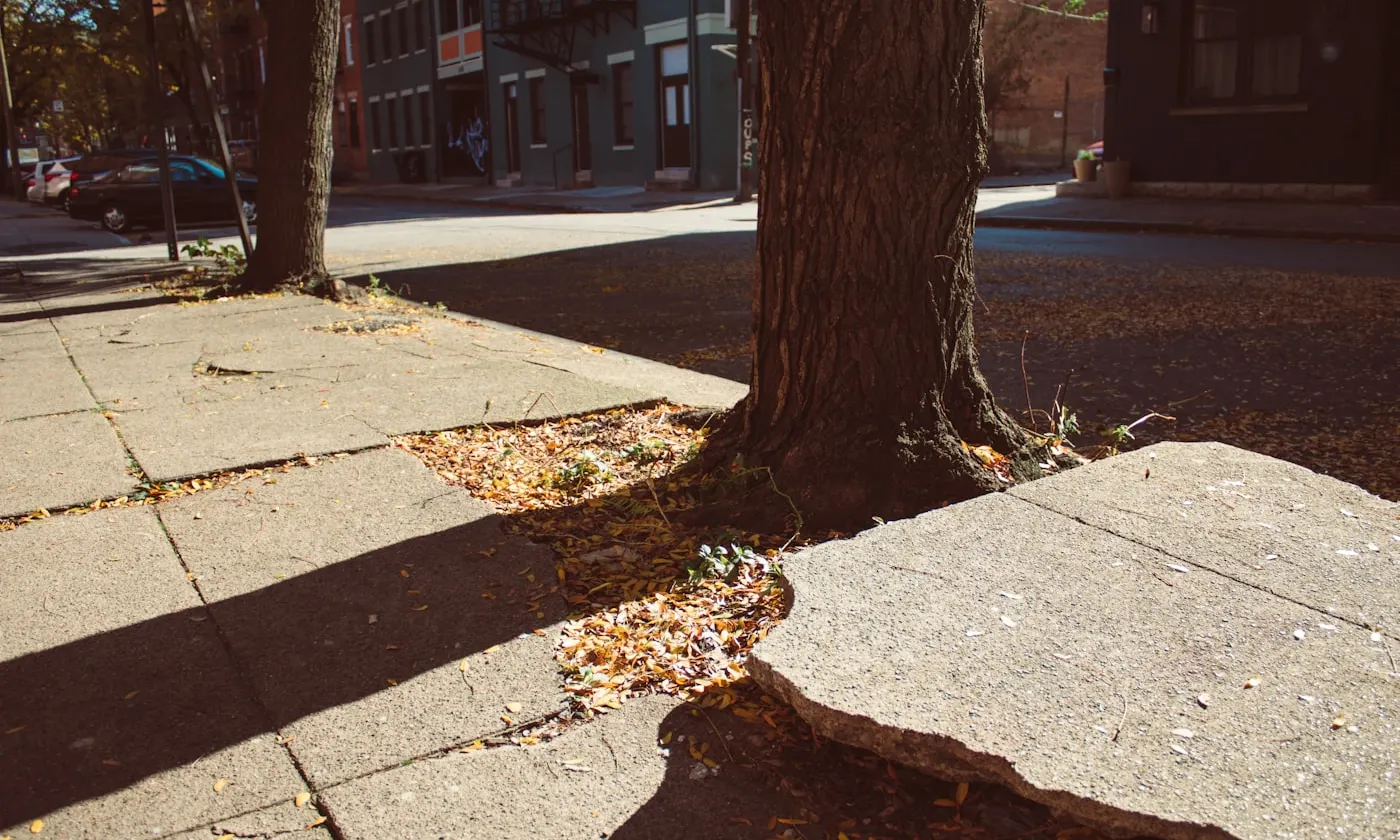
A raised slab of concrete an inch or two above the one next to it is enough to stop a foot mid-stride. People fall forward, land on an outstretched hand or a hip, and end up with a fractured wrist, a broken shoulder, a hip fracture or a head injury. Tree roots, missing pavement, unmarked height differences, sunken utility covers and construction plates left behind are the usual causes, and in older Valley neighborhoods they are everywhere.
Manoukian Law Firm represents people injured in sidewalk falls throughout California. Every case is prepared as though it will be tried, from the first conversation through resolution. These claims often run against a city, which means the time to act is much shorter than most people expect.
What to do after a sidewalk fall
- Photograph the defect the same day, before anyone repairs it. Include a wide shot showing the location, close shots of the height difference, and something for scale such as a coin or a phone next to the lip.
- Note the exact address, the nearest house or business number, and which direction you were walking.
- Get medical care and describe how the fall happened, so the mechanism of injury is in the record from the start.
- Ask any witness for a name and phone number, and ask nearby residents or businesses whether anyone has fallen there before.
- Keep the shoes you were wearing and do not repair or alter them.
- Write down what happened while it is fresh, including the time, the lighting and anything that blocked your view of the defect.
- Talk to an attorney quickly. In Los Angeles and other public entity cases, a written claim is generally due within six months.
How these cases work in California
A sidewalk fall is a premises case. The framework comes from Rowland v. Christian, and the practical questions are the ones a jury will be asked: was the condition dangerous, did the responsible party know about it or should it have known through reasonable inspection, and was there a reasonable chance to repair it or warn about it before someone was hurt.
Notice is usually the heart of the case. Actual notice means someone reported it or an employee saw it. Constructive notice means the condition existed long enough that reasonable inspection would have found it. A crack that opened yesterday is a different case from a slab that a tree lifted three inches over several years, with weathering, patch marks and prior complaints to show for it.
Responsibility can rest with more than one party. In Los Angeles and other California cities, the public entity that owns and controls the walkway can be liable for a dangerous condition of public property. Owners of adjacent property can also be responsible, particularly where their tree, their driveway, their landscaping, their sprinklers or their construction work created or contributed to the hazard, or where they took on repair or maintenance of the area. City ordinances vary on how repair duties are allocated, and the correct defendants are identified by investigating the specific location rather than assuming.
California uses pure comparative negligence under Li v. Yellow Cab. If a defendant argues you should have been watching where you were walking, a share of fault reduces the recovery rather than ending the claim. That argument is common in sidewalk cases and it is not a reason to give up on one.
These falls sit alongside our slip and fall and pedestrian accident practice, and where a fall causes a head strike, the brain injury page explains why symptoms are often delayed.
How Manoukian Law Firm handles sidewalk claims
The first task is fixing the location and the condition before either changes. Sidewalk defects get repaired, sometimes within days of a fall, and once the concrete is replaced the evidence is gone. We document the site with measurements and photographs, preserve what exists, and look for the history: prior complaints and service requests, repair records, tree maintenance records, permits pulled for nearby work, and inspection practices for that stretch of walkway.
We then determine who controlled the area. That means identifying the public entity, the adjacent owner, any tenant with maintenance responsibilities, and any contractor whose work created the condition. Where a public entity is involved, we prepare and file the government claim under Government Code section 911.2 within the six-month window and track the deadlines that follow.
On the medical side, we collect the treating records and billing and, in cases with lasting injuries, work with the treating physicians so the long-term picture is documented by the doctors providing care. We handle communications with the insurers and the entity’s risk office. Every case is prepared as though it will be tried. Our office is in Chatsworth on Topanga Canyon Boulevard, and the San Fernando Valley is home ground, but the firm represents injured people across California and meets clients by phone, video or in the hospital when travel is difficult.
What can be recovered
California allows recovery for what the injury actually cost and actually took away. On the economic side that is emergency care, surgery, hardware, physical therapy, follow-up treatment, assistive equipment, home care and the future care a physician expects will be needed. It also covers income lost during recovery and reduced earning capacity when the injury changes what someone can do for work. Medical damages are measured by the amounts actually paid or owed under Howell v. Hamilton Meats.
It also covers non-economic harm: pain, limited use of a hand or hip, difficulty sleeping, the loss of walking routines and independence, and the caution that follows a bad fall. Older adults in particular can lose a level of independence that never fully returns, and that loss is part of the claim. When a fall causes a death, wrongful death claims under Code of Civil Procedure section 377.60 belong to a spouse, domestic partner, children and certain dependents.
Deadlines
The general California limit for personal injury is two years from the date of injury under Code of Civil Procedure section 335.1. Where a public entity is responsible, a written claim is generally due within six months under Government Code section 911.2, and a shorter lawsuit deadline follows the entity’s response. Because most Los Angeles sidewalk cases involve the city, the six-month rule is the one that usually governs, and it runs from the date of the fall, not from the date you learned who owned the sidewalk. Do not wait.
Case results
Our client suffered catastrophic injuries after being struck by a commercial delivery driver who was on the job.
Our client developed ongoing neck pain after a multi-vehicle rear-end collision on the highway, requiring pain-management treatment. The case resolved for $400,000.
The other side valued our client's injuries at $5,000 to $10,000 and called it a “soft impact.” Our client was the third car struck in a chain-reaction collision. We filed suit and recovered $275,000.
Past results do not guarantee a similar outcome.
Frequently asked questions
How big does the defect have to be?
There is no fixed measurement that decides it. Courts look at the whole picture: the size of the height difference, the lighting, whether the defect was visible, whether debris or leaves covered it, how long it had been there and whether it had been reported. Small differences in an area with heavy foot traffic and poor lighting have supported claims.
Is the city or the homeowner responsible?
It can be either, and sometimes both. The public entity that owns and controls the walkway may be liable for a dangerous condition, and an adjacent owner may be responsible where their tree, driveway, landscaping or work created the hazard or where they undertook to maintain the area. The answer depends on the specific location and its history.
The sidewalk was repaired after my fall. Is my case over?
No. A repair after the fact does not by itself decide the claim, and the repair record itself can help establish who was responsible for the location. This is why photographing the condition immediately matters so much.
What does it cost to have you look at my case?
Nothing. Consultations are free, the firm works on a contingency fee, and there is no fee unless we win.
If you were hurt by a broken or uneven sidewalk, the clock may be shorter than you think and the evidence may not survive the month. Call Manoukian Law Firm at (818) 818-5031, day or night, or reach us through the contact page. The firm helps clients in English, Spanish and Armenian, the consultation is free, and there is no fee unless we win.
Serving clients across California
The office is on Topanga Canyon Boulevard in Chatsworth, and the firm represents injured people throughout California. If you cannot travel, we meet by phone, by video or in the hospital.
Most of the firm’s clients live and drive in the San Fernando Valley. See how cases are handled in Chatsworth, Northridge, Reseda, Canoga Park, San Fernando and Simi Valley, or browse every community the firm serves.